Sunday, July 11, 2010

The Classical Past


This lovely painting, A View of Ancient Rome, by Samuel  Palmer (1805-1881), captures the Mediterranean beauty of this great city of Antiquity.  Rome, once the seat of the world's most powerful empire, was toppled by a gentle Shepherd.
For more glimpses into the Classical Past from this perspective, please visit my blog, A Love of the Classical Past.

Sunday, July 4, 2010

We Cannot Forget . . . .

God in His graciousness has given this country so many blessings, the most important of which is the freedom to love and worship Him freely. Any "rights" that we may have actually are gifts from Him.  Men and women have courageously fought and died throughout our History to defend these freedoms and gifts.

I am worried about this wonderful country that He has given us, not because of the economy, the terrible oil spill, the positioning of yet another radical abortion rights supporter on the Supreme Court, but because we seem to be pushing Him out of our culture, our laws and our lives  with more haste and determination than ever before.
We cannot forget that we are "One Nation Under God."

Tuesday, June 29, 2010

Is Anyone Paying Attention?

Friday, June 25, 2010

A Different Fourth Estate


This summer in our Readings Course on the Pacific Theater of World War II, my students were assigned Guadalcanal Diary by Richard Tregaskis.  Tregaskis, a Harvard-educated journalist, was an "embedded" reporter with US Marines as they embarked on one of the first major amphimbious landings of the War. The prize was an airstrip the Japanese were building in the Solomon Islands.

My students were struck by a number of interesting aspects of the narrative--each sharp contrasts with today's print media.  The curse words were each represented by the first letter and then a series of dashes. We all had a good laugh at that!

 Another major departure from today's writings was the absence of political correctness. The Japanese were consisitently referred to as the "Japs." The Americans hated the enemy, not because they were Japanese, but because they were the enemy; they were the enemy because they bombed Pearl Harbor. There were no apologetic passages about name-calling or racism.

Another key difference between this brave journalist and today's reporters was that Mr. Tregaskis seemed to be on America's side!!!  Imagine that!  He didn't seem determined to report every misstep or mistake; he didn't show sympathy for the enemy and he certainly didn't reveal secrets that compromised the security of the war effort or the nation.  Where is that Fourth Estate today?

Sunday, June 13, 2010

A Beautiful Princess and Some Thoughts

This lovely painting is of none other than the marvelous Queen Elizabeth II.  We spent about 5 months in England in 1995, and I fell madly in love with the English people and their culture.  When we were there, Michael and I made of point of trying to be as positive and enthusiastic about all things British as we could. After all, we were guests in their splendid country. Some of the others in our group sadly fulfilled the stereotypical "ugly American" role by criticizing as much as possible. I was embarassed by their behavior.  We found the English people to be very kind, and we realized that there in Lincolnshire, we were the ones with the hard-to-undestand accents!

I was disappointed and hurt recently by the inappropriate and untrue remarks made by my once-favorite Beatle.  As a guest in the White House, Paul McCartney  used a very public occasion to blast President George W. Bush. If Sir Paul had made similar remarks about the current President, I would have felt just as incensed. I think that the Hollywood/Music Industry community believes that to trash a politically conservative American politician is to increase their own popularity. Sadly, this is all too true of the academic community as well.

Sir Paul will never be troubled one minute by this irate American's opinion, and he'll never realize that he is teaching a generation how not to act when visiting abroad! But at least I know this commoner from the American South had more manners when visiting "across the pond."

Wednesday, June 9, 2010

First Ladies

Today marked the last day of lectures in the First Ladies course; the students have quite a bit of reading and research  yet to do for their final project. We had a great discussion this afternoon  about the First Ladies of the 20th Century.  I came away with the feeling that the role of First Lady has not changed so very much since Martha Washington's era.  The President's wife remains primarily a hostess, unofficial advisor to the President and wearer of beautiful inagural gowns!  We have seen that the most controversial First Ladies have been those who  took their unoffical advisory roles into the public eye: from Abigail Adams to Hillary Clinton, the women who had high profile political roles received the  harshest criticisms.

Most of the First Ladies of my lifetime are in this lovely picture. My heart is tender for the physically frail Pat Nixon.  Mrs. Nixon was really something very special, and I hope History will recognize that about her.  She had such a difficult time with the ups and downs of her husband's political career. But the same must be said for all of the ladies married to the Presidents of the United States.  Abigail Adams once stated, "when my husband is wounded, I bleed."  Surely that simple statement captures the heartaches of these special women.

I have enjoyed exploring this topic with my students, and we have all learned more about our Nation's First Ladies.

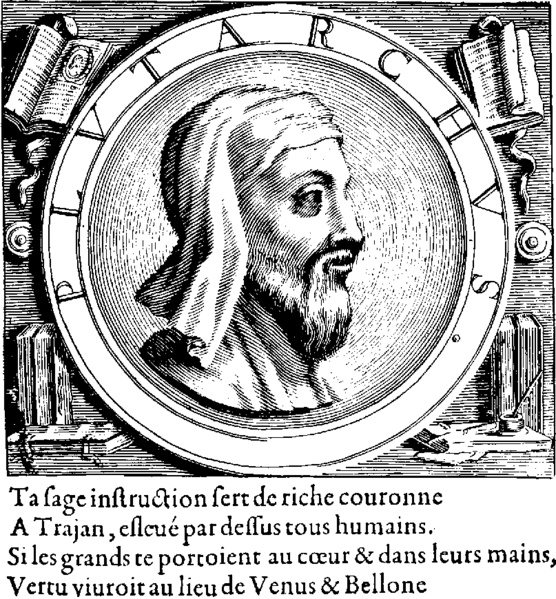
Plutarch


An approach to History that has fallen out of favor with contemporary historians is the study of "great men."
Revisionists want to cast all of history as a product of class conflict and economic catalysts.  I prefer the "great man" approach and have taught this way throughout my academic experiences.
In the History of Ancient Greece and Ancient Rome courses, we use the writings of the Greek biographer, Plutarch (c. 46-122).  He wrote biographies of the great Greeks and Romans. These character studies are not like Parson Weems' accounts of George Washington, but include the unflattering along with the praise.

Plutarch is not easy to read, and  has proven quite a challenge to my students in past semesters. But, they persevered, and felt a great sense of accomplishment in so doing.  This fall, we will return to Plutarch in the History of Amcient Greece, and I am looking forward to watching the students grow in patience and historical knowledge as they walk back in time with this great Greek biographer.